|
David Fear Sr. is no stranger to success. Behind his tough exterior and equally strong moniker resonates a man that is deeply passionate and optimistic about the status and future of health insurance. As thoughtful as he is passionate, David Fear Sr. shares with us that all that is necessary to succeed is a strong will, determination, and the right tools.
 David Fear Sr. is the outgoing President of the National Association of Health Underwriters (NAHU). He is the President of the Fear Corporation, where he works side-byside with his sons David Fear Jr. and Michael Fear. David Fear Sr. is the outgoing President of the National Association of Health Underwriters (NAHU). He is the President of the Fear Corporation, where he works side-byside with his sons David Fear Jr. and Michael Fear.
Quotit: Tell me a little about your agency and what
insurance lines you market?
Fear: We market employee benefits, small group,
dental, vision, and life and disability. The Boys (sons David,
Jr. and Michael) sell a lot more individual, workers
compensation, E & O, and property & casualty lines.
Quotit: How has your agency changed the way you do
business in the last 5-6 years?
Fear: The agency changed a lot in 2002 when the boys
came along. My sons were early in their careers and they needed
to get a feel for the different product lines in the
marketplace. We changed our focus from solely marketing small
group, which is what I had been doing on the side, to a broader
range of products. We looked into offering other lines of
coverage as a result of them getting involved; workers
compensation being a good example.
Quotit: What types of traditional marketing did you
use?
Fear: It hasn’t changed a lot in the last several
years. We knew early on that we needed an online presence.
Quotit’s system allows us to generate online health insurance
proposals for people, which gives us a better opportunity to
close the sale. I believe that we provide a service where people
can come to our website and feel like they can get a quote and
see options. We have a lot of tire kickers on our website, so
the boys follow-up with the prospects to answer any additional
questions.
Quotit: What expectations do you have when running a
marketing program?
Fear: Most of what we’re doing right now is online
marketing through association endorsements. Typically, if we are
endorsed by an association to provide insurance to their members
we immediately get a link from the association’s website to our
website. We get leads from people who visit the website and get
an online quote. Our website contains forms and applications
that they can fill out to request online information. Those turn
into leads that my sons can work.
Quotit: How do you provide proposals for customers?
Fear: I really only count the time since the boys got
in the business. Prior to 2002 we provided traditional
proposals. After the boys joined the business in 2002 we
converted solely to an online proposal system. Occasionally a
carrier will send us a proposal through a PDF, but for the most
part we are exclusively using the Quotit proposal system.
Quotit: What impact has been made by taking your
business online?
Fear: In general people want to go online and do their
research without being bothered by a sales person. The Quotit
systems allows prospects to do their research, but it also helps
us maintain those leads so we can follow up with them at the
appropriate time with a personal phone call, or at the very
least a letter sent by a real person.
Quotit: What percentage of your business now comes
from online?
Fear: We are probably doing 90% of our online
marketing through an association’s online presence. With our
Quotit website, we are getting a quality lead every time someone
visits the site. Of the leads that we get from our website we
close about 75%.
Quotit: What is the biggest value added by offering
online proposals to customers?
Fear: For example, when a small business owner
contacts us we lead them to our site. We take their basic
information over the phone, then ask if we can walk them through
the site and show them how it works. After that initial contact
they can come back and research programs that fit their needs.
It’s interesting to see how many times they come back to the
site just to look around. Usually, they will call us back and
they’ll tell us, ‘I like this plan with these benefits.’ And
they’re done. We meet with them and close the sale.
Quotit: What one factor has made your agency more
effective since working with Quotit?
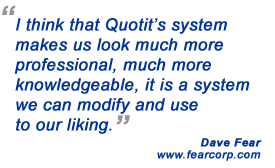
Fear: I think that Quotit’s system makes us look much
more professional, much more knowledgeable, it is a system we
can modify and use to our liking. It certainly helps us be more
competitive with the big shops out there.
Quotit: In your opinion, what role will online
technology play with your agency’s success in the future?
Fear: There is no question that we can’t go backwards.
We need to use the most efficient tools we can find, and pay the
right price for them. We can do a better job of running our
agency and managing all of our information by having a better
and more concise online database.
Quotit: Do you have any hobbies?
Fear: For the last 12 months I’ve served as President
of NAHU, and that really has been my hobby for the last year.
Quotit: Where do you see your agency heading in the
next 5 years?
Fear: We are looking at some very interesting and very
exciting new opportunities. In general our plan is to expand, we
want to bring on some young hungry producers and give them an
opportunity to go out and make a good living. Above all, we want
to do things ethically and professionally so that when our
customers and our prospective customers hear about our agency
they can say, “Yeah these guys seem to know what they are
doing.”
|